What We Have Achieved
I found the workshops, presented by VFM business advisors to be really useful and cover the major topics necessary in this stage of my business career. The content was delivered in small understandable pieces, with plenty of time for Q&A. Steve in particular stood out as knowledgeable and someone who's advice you could trust. The way he drew on his real life experiences to contextualise issues helped with my understanding and made for interesting listening.
My ideas about the business have changed drastically as a result of this experience. At the first workshop I was preparing to sell safety equipment, but after group discussions and one to one meetings with the supportive team at Old Broadcasting House, I now find myself embarking on an exciting joint venture with ELHFA.
The workshops have helped me to cement my ideas, and given me the direction and drive to take the first steps. Completing all of the exercises discussed during the workshops along the way, complemented by an extensive consultancy project for ELHFA, has now provided me with the basic tools and a ‘road map’ to get going.
I have achieved the following:
Elevator Pitch – defining TEDA concisely
Defined USPs of products, and TEDA to form our company proposition
Decided on Limited company status - with day to day operations under my jurisdiction
Named the company – The Ethnic Diet Association
Understood Terms of Business requirements – and begun to compose drafts
Realised how to maintain control – through holding the casting vote with 51% share
Gained insight on intellectual property
issues - discussed potential patent for VTAs
Understanding of book-keeping and basic
records – Cash Book, Bank Reconciliations, Petty Cash, and Invoicing
Gained insight on year end accounts – when they are due, and what they must include
Learnt about my responsibilities as a director
Completed analysis of the marketing environment, buyer behaviour and competitors
Completed a PEST analysis for TEDA
Performed a competitive sweep for TEDA
Segmented the market through Porters 5 Forces
Learnt about generic marketing strategies – including differentiation and marketing management
Created a marketing mix for TEDA – product, price, place, promotion
Gathered prospecting data – and learnt where to source this information
Created a direct mailer for TEDA – and learnt about the correct approach
Prepared a cold calling script – including qualification questions and objection handling
Identified features and benefits
Learnt how to close a deal
Gained a basic understanding of how to apply NLP and its various advantages
Realised the importance of networking - how it is a life skill, and gained some practice
Learnt where to network and about online resources
How to market yourself as ‘brand you’
It’s easy to see that I’ve learnt an awful lot during the incubator workshops, more than ever I’m feeling prepared and confident about being self employed and following my dream.
If you’re interested in business or perhaps thinking of going to uni, and still looking for that killer course then I would recommend doing BA Hons Business Creation and Enterprise, as it is more hands on than many courses and a great starting point for your business. Everyone here has been really helpful and a pleasure to work with.
I hope this blog has been interesting and given you some helpful hints – if not then check out my post with my 12 top tips for business start-ups!
Showing posts with label nlp. Show all posts
Showing posts with label nlp. Show all posts
Saturday, 18 April 2009


Wednesday, 15 April 2009
Post 11: Neuro Linguistic Programming
So I’ve learnt some basic sales skills and techniques, which is half of the battle, but a lot of people speak about ‘the psychology of sales’ to give them the competitive edge. We learnt more about this psychology and how it can be used in business by attending a lecture on NLP, provided by Caroline Edwards of Satsuma-NLP.
Like many people, I have encountered NLP in the past (my secret love of Derren Brown), but it was great to finally speak to a professional and learn the ‘nitty-gritty’ of the subject.
So, NLP, it’s a fancy title, but what does it mean?
In its simplest form, NLP is a system of communication to get results. It was first devised in 1949 and evolved by John Grinder and Richard Bandler in the mid 70s. The 2 college friends admired successful therapists such as Erickson and Jung, and ‘elicited the strategies’ of these top professionals to turn them into a model of how language is processed by the brain. This information could then be taught to anyone to improve their listening and communication skills.
Grinder and Bandler argue that the language we use can have a powerful affect on the unconscious neurological processes of the listener. By employing NLP techniques, it is possible to gain an insight into how others want you to communicate with them to best effect, and build rapport quickly for successful selling, Yemm (2006).
Modern NLP practitioners identify 5 types of people based on the 5 different senses (usually one or two senses are prevalent), and they suggest you adopt specific approaches when communicating with each type of person. i.e. when selling to a ‘Visual Person’ (uses language like “I can’t see that product fitting in here”) you should use descriptive language to create pictures for them.
The 5 Different Categories
Below is a table detailing the types of person, the characteristics to spot in identifying each type, and then how to communicate/sell to these people for best effect.

Obviously everyone was keen to hear Caroline’s ‘diagnosis’ on their NLP type to see if the theory worked. Caroline said she felt I was predominately auditory, with some kinaesthetic traits. I imagined I would have had a visual/audio mix given my tendency to imagine pictures, love of music and use of ‘proper language’, so although I was surprised with the result, I agree with her.
Rapport
Rapport happens all around us, and most of the time we barely even notice, it’s that hour long conversation with a friend over coffee that seemed like it lasted 10 minutes. Both parties are deeply engaged in conversation and active listening – you could call this ‘subconsciously connecting’.
In a business scenario, rapport is making this connection and engagement which improves a seller’s chances of success. NLP can be used to quickly build a rapport, Nancarrow (1998), and applies to all interactions, including clients, suppliers and potential customers.
Caroline mentioned only around c7% of communication comes from the spoken word, with 55% from physiology (body language), and 38% tonality (use of pitch/tone).
Whereas traditional NLP techniques related purely to language, modern techniques build on more physiological aspects such as ‘Mirroring’ body language and breathing patterns. By employing these NLP techniques further subconscious rapport can often be established quickly. However, you must approach this with caution; being too obvious in mirroring body movements could most likely make others feel uncomfortable.
Improper use of NLP techniques, as mentioned above, could cause ‘Synaesthesia’ in the recipient. This isn’t a good thing, as essentially 2 of their senses overlap and they become subconsciously confused, uncomfortable and therefore stop absorbing information.
I was fascinated when Caroline said she could always spot a liar through their eyes. NLP practitioners recognise that your eyes tend to move in different places dependent on brain function, and that these movements can be generalised for most people.
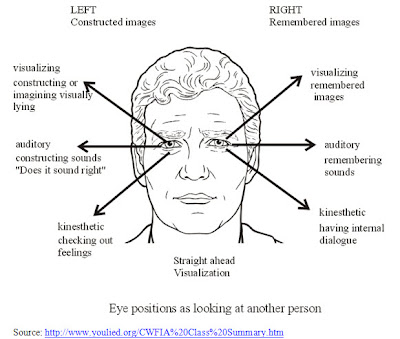
So the picture above shows the most common eye positions which give insight into how people’s brains are processing data. To put this into perspective if you asked someone if they like the Rolling Stones, as they think of their answer they will probably look to the left as they remember the sound, if kinaesthetic, they may look down and to the right, while they connect with their feelings about the Rolling Stones.
Constantly monitoring people’s eye movement in everyday life is a little extreme, but if you are in a specific situation looking for patterns of where people’s eyes are during speech may it may offer further insight to their true thoughts/feelings.
Conclusion
I definitely believe that the workshop on NLP helped to improve my confidence and knowledge going into sales situations, for example:
- When completing market research I spoke to various existing VTA distributors and potential suppliers, paying particular attention to their use of language. By picking up on subtle suggestions, managed to turn a telephone interview into a sales pitch with one of the largest distributors in the UK.
- I know the importance of varying my tone in conversations, especially telephone calls where physiological signals can’t be projected. This will also appeal specifically to auditory people.
- Not to try too hard to notice the NLP signals – I now find myself trying to ‘decode’ people, and barely hear a word of what they’re saying!
Due to my previous interest in NLP I went straight home and did some research. My impression is that the pragmatic approach of the originators (Grinder & Bandler) has now been swamped in a huge industry of ‘gimmicky’ theories and false promises. I do however acknowledge NLP is an effective tool if used wisely.
Recommended links:
• www.satsuma-nlp.co.uk (Caroline’s company)
• www.nlp3.co.uk
• NLP in business – www.ciauk.com
Like many people, I have encountered NLP in the past (my secret love of Derren Brown), but it was great to finally speak to a professional and learn the ‘nitty-gritty’ of the subject.
So, NLP, it’s a fancy title, but what does it mean?
In its simplest form, NLP is a system of communication to get results. It was first devised in 1949 and evolved by John Grinder and Richard Bandler in the mid 70s. The 2 college friends admired successful therapists such as Erickson and Jung, and ‘elicited the strategies’ of these top professionals to turn them into a model of how language is processed by the brain. This information could then be taught to anyone to improve their listening and communication skills.
Grinder and Bandler argue that the language we use can have a powerful affect on the unconscious neurological processes of the listener. By employing NLP techniques, it is possible to gain an insight into how others want you to communicate with them to best effect, and build rapport quickly for successful selling, Yemm (2006).
Modern NLP practitioners identify 5 types of people based on the 5 different senses (usually one or two senses are prevalent), and they suggest you adopt specific approaches when communicating with each type of person. i.e. when selling to a ‘Visual Person’ (uses language like “I can’t see that product fitting in here”) you should use descriptive language to create pictures for them.
The 5 Different Categories
Below is a table detailing the types of person, the characteristics to spot in identifying each type, and then how to communicate/sell to these people for best effect.

Obviously everyone was keen to hear Caroline’s ‘diagnosis’ on their NLP type to see if the theory worked. Caroline said she felt I was predominately auditory, with some kinaesthetic traits. I imagined I would have had a visual/audio mix given my tendency to imagine pictures, love of music and use of ‘proper language’, so although I was surprised with the result, I agree with her.
Rapport
Rapport happens all around us, and most of the time we barely even notice, it’s that hour long conversation with a friend over coffee that seemed like it lasted 10 minutes. Both parties are deeply engaged in conversation and active listening – you could call this ‘subconsciously connecting’.
In a business scenario, rapport is making this connection and engagement which improves a seller’s chances of success. NLP can be used to quickly build a rapport, Nancarrow (1998), and applies to all interactions, including clients, suppliers and potential customers.
Caroline mentioned only around c7% of communication comes from the spoken word, with 55% from physiology (body language), and 38% tonality (use of pitch/tone).
Whereas traditional NLP techniques related purely to language, modern techniques build on more physiological aspects such as ‘Mirroring’ body language and breathing patterns. By employing these NLP techniques further subconscious rapport can often be established quickly. However, you must approach this with caution; being too obvious in mirroring body movements could most likely make others feel uncomfortable.
Improper use of NLP techniques, as mentioned above, could cause ‘Synaesthesia’ in the recipient. This isn’t a good thing, as essentially 2 of their senses overlap and they become subconsciously confused, uncomfortable and therefore stop absorbing information.
I was fascinated when Caroline said she could always spot a liar through their eyes. NLP practitioners recognise that your eyes tend to move in different places dependent on brain function, and that these movements can be generalised for most people.

So the picture above shows the most common eye positions which give insight into how people’s brains are processing data. To put this into perspective if you asked someone if they like the Rolling Stones, as they think of their answer they will probably look to the left as they remember the sound, if kinaesthetic, they may look down and to the right, while they connect with their feelings about the Rolling Stones.
Constantly monitoring people’s eye movement in everyday life is a little extreme, but if you are in a specific situation looking for patterns of where people’s eyes are during speech may it may offer further insight to their true thoughts/feelings.
Conclusion
I definitely believe that the workshop on NLP helped to improve my confidence and knowledge going into sales situations, for example:
- When completing market research I spoke to various existing VTA distributors and potential suppliers, paying particular attention to their use of language. By picking up on subtle suggestions, managed to turn a telephone interview into a sales pitch with one of the largest distributors in the UK.
- I know the importance of varying my tone in conversations, especially telephone calls where physiological signals can’t be projected. This will also appeal specifically to auditory people.
- Not to try too hard to notice the NLP signals – I now find myself trying to ‘decode’ people, and barely hear a word of what they’re saying!
Due to my previous interest in NLP I went straight home and did some research. My impression is that the pragmatic approach of the originators (Grinder & Bandler) has now been swamped in a huge industry of ‘gimmicky’ theories and false promises. I do however acknowledge NLP is an effective tool if used wisely.
Recommended links:
• www.satsuma-nlp.co.uk (Caroline’s company)
• www.nlp3.co.uk
• NLP in business – www.ciauk.com
Subscribe to:
Posts (Atom)


 Posts
Posts


